
Moving forward with the Women’s Manifesto
- Wolrec

- Dec 18, 2025
- 3 min read
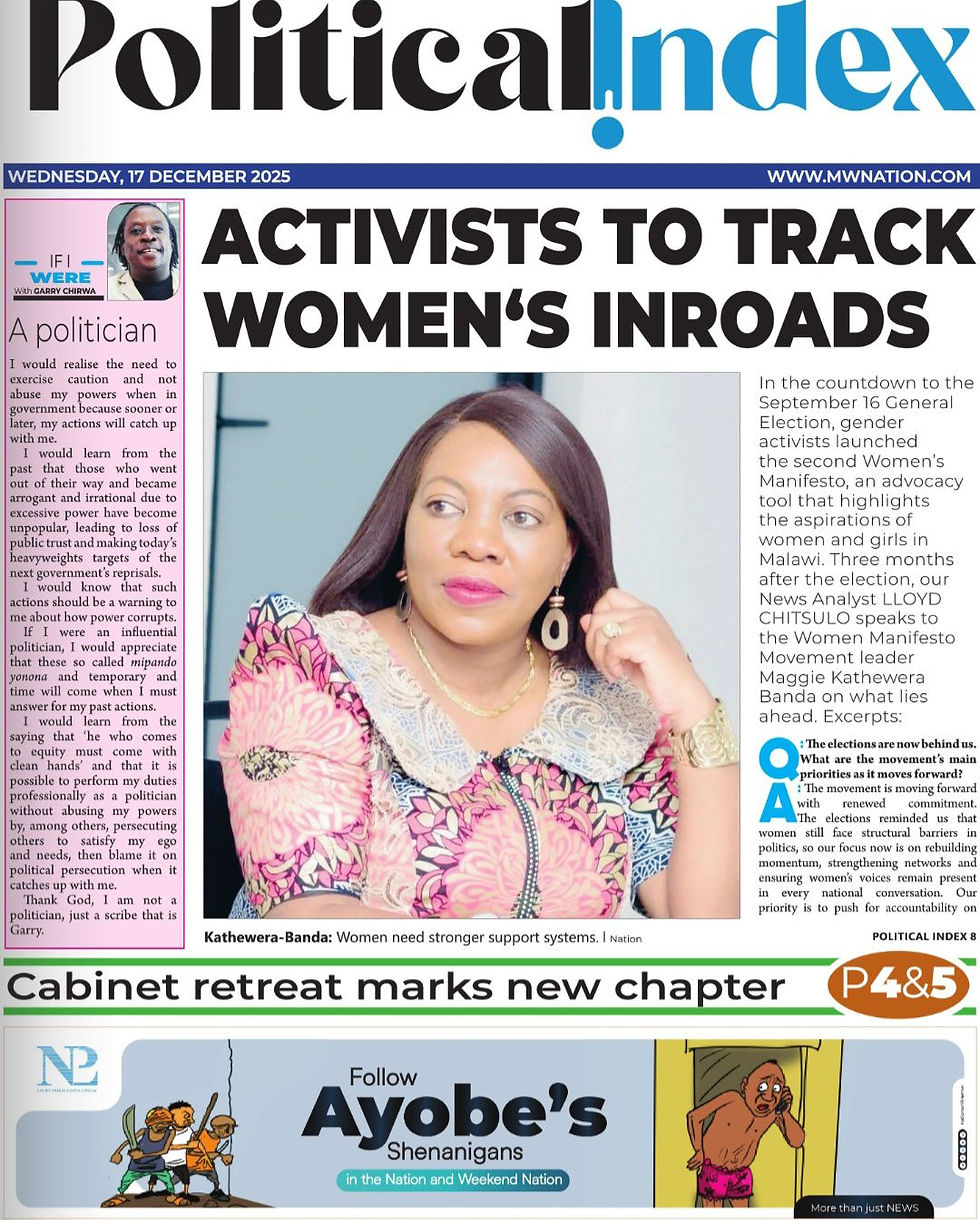
In June this year, the Women’s Manifesto Movement launched the Second Edition of the Women’s Manifesto, the advocacy tool that highlights the aspirations of women and girls in Malawi. This launch was strategic as they aimed to influence the political agenda ahead of the General Elections. Now that the elections are over, Our Reporter Lloyd Chitsulo engaged the Originator of the Manifesto Maggie Kathewera Banda, who is also the Executive Director of the Women’s Legal Resources Centre (WOLREC) and Chairperson of NGO Gender Coordination Network, on how they plan to move forward with the Manifesto... Excerpts

Q. The elections are now behind us. What are the movement’s main priorities as it moves forward?
A. The movement is moving forward with renewed commitment. The elections reminded us that women still face structural barriers in politics, so our focus now is on rebuilding momentum, strengthening networks and ensuring women’s voices remain present in every national conversation. Our priority is to push for accountability on the commitments made during the elections. We also want to sharpen our advocacy on women’s political participation, economic empowerment, provision of social amenities and prevention of Gender-based violence including Intimate Partner Violence among others.
Q. What activities or interventions can the public expect to see in the coming months?
A. Expect more community dialogues, policy engagement meetings, local women’s movements strengthening among other activities. We are also tracking implementation of the Women’s manifesto demands using Gender Observatory. You may recall that WOLREC launched a Gender Observatory which is an Online platform to track what is happening within the gender space. Using this platform, WOLREC will on annual basis in collaboration with members of the Women’s Manifesto Movement be producing reports called Gender Trackers.
Q. What lessons did the movement learn from the recent election period and what needs to improve?
A. We learned that women need stronger support systems to participate meaningfully. We also realized the importance of grassroots mobilisation and early preparation rather than waiting for the election year. We also realized that Countries that have done well with regard to having equal representation of women in elective positions have been able to do the same because of progressive legal frameworks and therefore this is a big lesson to us that if Malawi is to witness more women in Parliament and Local councils, a law on quotas is necessary.
Q. How does the movement plan to strengthen its work on gender-based violence and women’s rights?
WOLREC which is the secretariat of the Women’s Manifesto movement is leading two other women’s rights organisations namely WAG Disability and GENET in a consortium called Pamodzi Kukhetsa Nkhanza (PKN) funded by FCDO under their Global What Works to prevent Violence against women and girls at Scale. So, we will continue working with communities in Balaka and Lilongwe (where the project is being implemented) using SASA! Together approach and Moyo Olemekeza (family based approach which works with husband and wife as well as influential relatives from both sides). We will also continue working with response service providers using Gender Transformative Curriculum. As PKN, we will also continue working with the Ministry of Gender, Children, Disability and Social Welfare under our External Engagement and Influencing pillar in developing the new National Action Plan on Combating Gender Based violence. PKN will also continue supporting the Malawi Police Service to strengthen response system on Violence against women and girls.
Q. Which partners or institutions will be key in supporting the movement’s next steps?
Let me start by thanking the donors that are supporting WOLREC to undertake Women’s Manifesto Movement interventions. These include FCDO under their What Works Programme to prevent Violence against women and girls, European Union through OXFAM, Malawi Irish Consortium on Gender Based Violence as well as Trocaire. UN Women has also supported NGO Gender Coordination Network to participate in Women’s Manifesto interventions. As a movement we will continue working with the partners as well as state and non-state actors
Q. Looking ahead, what are the movement’s prospects for influencing the next election cycle?
A. Our prospects are strong. With the lessons we’ve gathered and the networks we have built, we believe we can shape the next election cycle. You may agree that the work which we did in advocating for gender balanced Presidential pairs was successful. We are proud that Malawi has a Female Vice President.
Q. What message does the movement have for Malawian women as it shapes its future agenda?
A. The movement is yours. It is a space to be used to amplify your voices on issues affecting your lives. So, we expect all women from all walks of life to utilise the space. If we do not raise our voices as women, no one else can ably do that for us. We must all rise to the occasion and demand better gender equality outcomes in all spheres of life.


Comments